Day 1: Wednesday, October 7th
Location: Ludwig Maximilian University of Munich, Main Building (Geschwister-Scholl-Platz 1, 80539 Munich), Room A 214 (2nd floor)
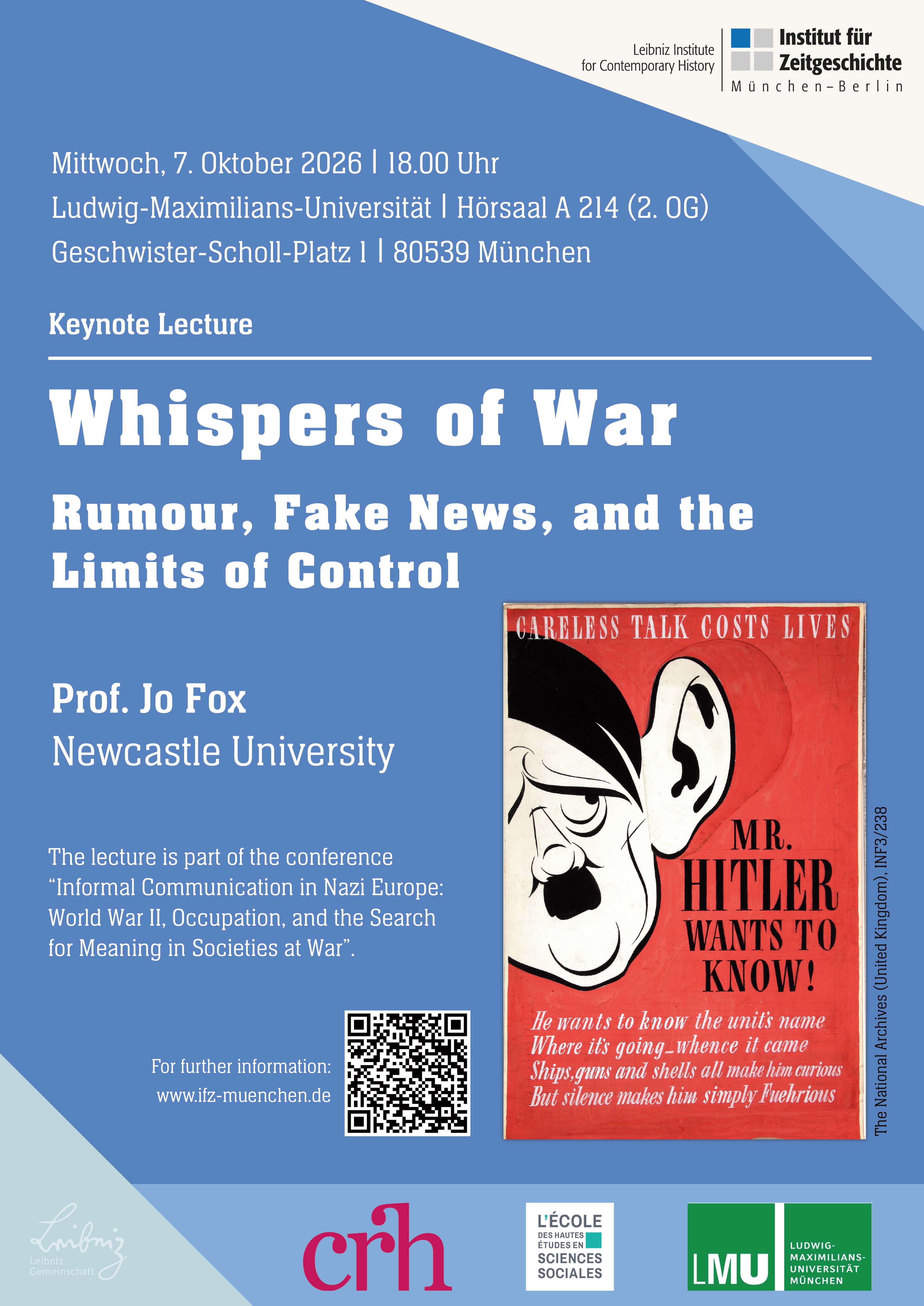
18:00 – 20:00: Public Keynote Lecture by Jo Fox (Newcastle University): “Whispers of War: Rumour, Fake News, and the Limits of Control”
Day 2: Thursday, October 8th
Location: Leibniz Institute for Contemporary History (IfZ) Munich, Main Building (Leonrodstraße 46B, 80636 Munich), Lecture Hall (ground floor)
9:00 – 9:10: Welcome by Isabel Heinemann (IfZ Director)
9:10 – 9:30: Introduction by Caroline Mezger (EHESS), “Informal Communication in Nazi Europe: World War II, Occupation, and the Search for Meaning in Societies at War”
9:30 – 11:00: Panel 1 – Paths to War
Chair: Jürgen Finger (German Historical Institute Paris)
- Manuel Mork (LMU Munich): “Counter-Knowledge and the Anecdotal Method: Wartime Rumors during the Battle of France, the Exode, and under German Occupation (1940–41)”
- Maude Williams (Universität des Saarlandes): “‘Your Houses Are Well Guarded’: Rumors of Looting during the Evacuation of the Franco-German Border Region (1939–1940)”
- Izabela Paszko (German Historical Institute Warsaw): “Communication and Survival: Regaining Agency in Wartime East Upper Silesia”
11:30 – 13:00: Panel 2 – Surveillance and State Control
Chair: Johannes Großmann (LMU Munich)
- Ariane Mak (Université Paris Cité): “Rumours and False Alarms in Wartime Britain: A Historical Anthropology of Suspicion”
- Marie-Bénédicte Vincent (Université Marie & Louis Pasteur, Besançon): “German Institutes in the Provinces of Occupied France (1940–1944): A Network of Informants for Nazi Germany?”
14:30 – 16:00: Panel 3 – Sense-Making under Nazi Occupation: Media, Practices, Counterpropaganda
Chair: Thomas Chopard (EHESS)
- Marjet Brolsma (University of Amsterdam): “Wartime Radio Propaganda and Fostering Passive Resistance through Informal Communication”
- Marie Fridrick (Université de Lorraine): “Feminine Engaged Poetry in Moselle: An Informal Way of Communication to Denounce the Nazis in a de facto Annexed Territory”
- Anna Onufriienko (Karlsruhe Institute of Technology): “Film-Making as Informal Communication: Camera, Interaction, and Forced Labor in Ukraine 1943”
16:30 – 17:30: INFOCOM Roundtable Discussion – “Informal Communication in Nazi Europe: Transnational Perspectives”
Moderation: Johannes Großmann (LMU Munich)
Day 3: Friday, October 9th
Location: Leibniz Institute for Contemporary History (IfZ) Munich, Main Building (Leonrodstraße 46B, 80636 Munich), Lecture Hall (ground floor)
9:00 – 10:30: Panel 4 – Experiencing Nazi Persecution
Chair: Marsha Siefert (Central European University)
- Damien De Santis (Mémorial de la Shoah, Paris): “Between the Lines: A Study of Discourses on Racial Deportations from France (1941–1945)”
- Hanna Lehun (Arolsen Archives): “‘I Would Write So Much More’: Letters of Ukrainian Forced Laborers under Nazi Rule”
- Daria Starikashkina (Justus Liebig University Gießen): “Rumors of Extermination: Informal Knowledge and Jewish Vulnerability in Besieged Leningrad”
11:00 – 12:30: Panel 5 – Knowledge of Nazi Persecution: Nascence, Circulation, Reverberations
Chair: Florent Brayard (EHESS)
- Sophie Küsterling (University of Luzern): “‘The terrible thing is happening in the Third Reich’: From Informal to Formal Circulation of Knowledge about the Nazi ‘Euthanasia’ Program in Switzerland”
- Caroline Mezger (EHESS): “Rumors of Atrocity: Forced Migration, Informal Communication, and the Emergence of Holocaust Knowledge”
- Michelle Gordon (Uppsala University): “Viewing Nazi Europe and the Holocaust through the Correspondence of British Soldiers”
14:00 – 15:30: Panel 6 – World War II and Postwar Transitions: Confronting Collapse
Chair: Roberta Pergher (Indiana University)
- Witali Gerber (Bundeswehr Military History Museum): “Everyday Correspondence as a Resource of Endurance: Youth, Fear, and Belonging in 1944–45”
- Jacopo Bernardini (University of Pisa): “Interpreting Collapse: Prefectural Authority in the Italian Social Republic and Vichy France”
- Felix Berge (University of the Bundeswehr, Munich): “‘Rumors Are All We Have Left to Live On’: A Local History of Informal Communication at the End of the Second World War”