
2025 |
Février 2025
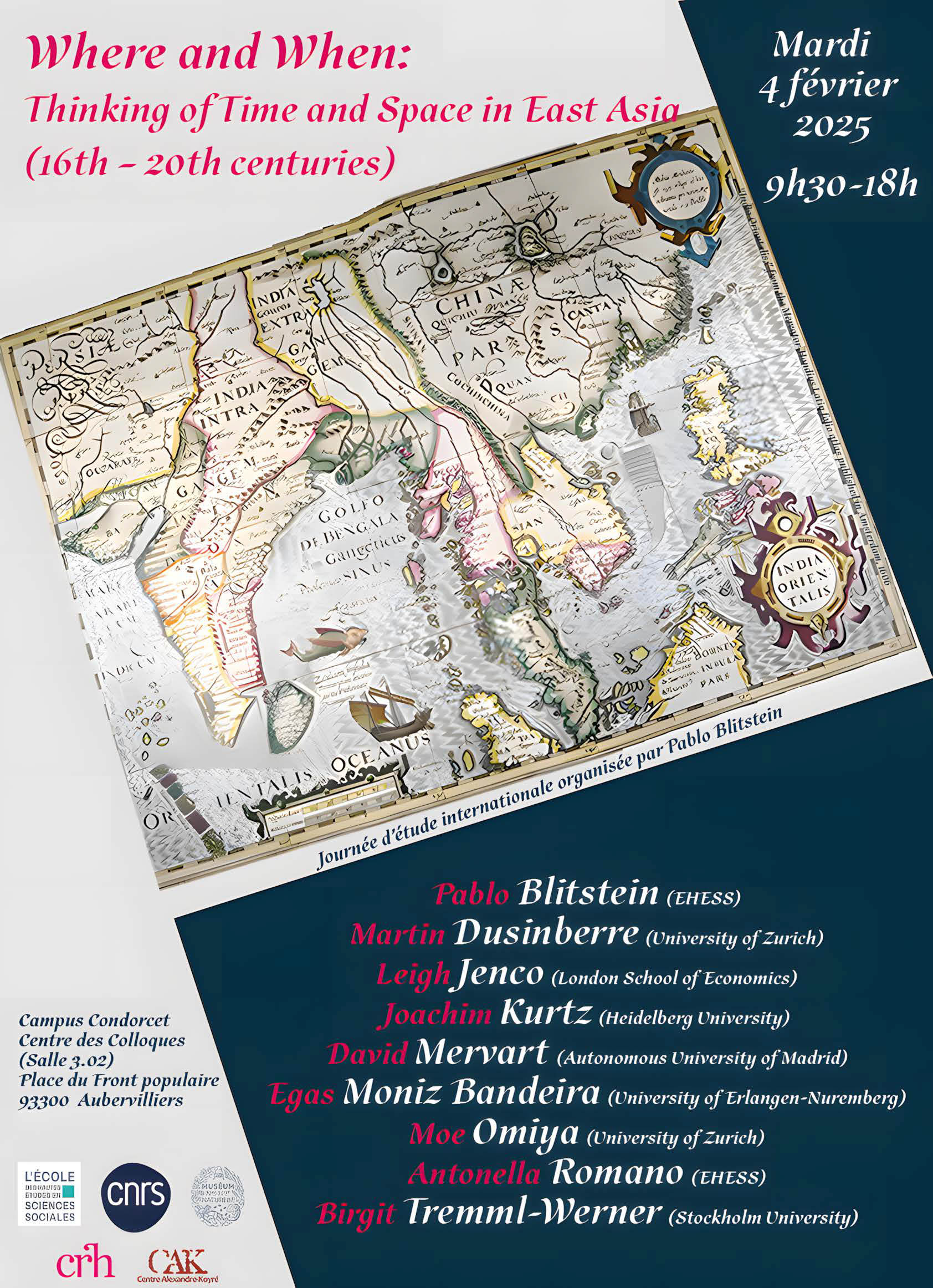
Where and When: Thinking of Time and Space in East Asia (16th – 20th centuries)
Mardi 4 février 2025 de 9h30 à 18h - Journée d'étude
Présentation
In a past European research project*, many of the speakers at this workshop gathered to explore how different actors in 16th-20th century East Asia conceptualized historical time. We mostly focused on representations of history and periodicity, particularly how different actors used topoi from the “European” historical past to shape their own perceptions of “East Asian” history. We examined how people in East Asia defined the relevance of past events by comparing them to European ones, how they circumscribed a “Middle Age” or a “Modernity” or wondered about the “age” they lived in. While discussing these questions, we realized that we could not think of time without thinking of space. Did the world have a single “present” or did each place –a group, a polity– have a time of its own? And if each “place” had its own time, what was the extent of this place? From the relation between history and territorial sovereignty to reflections on the “site” of historical time (“the Pacific Age”, the “Age of Empire”), we repeatedly encountered the same problem: how representations of time were intimately related to the perception and organization of space.
After the publication of a journal issue in the Historical Journal**, our discussions were disrupted by the COVID 19 pandemic. This year we would like to resume our project. Focusing on different case studies between the 16th and the 20th centuries, this workshop will address the following questions: what were the representations and uses of space underlying different intellectual activities and social practices, and to what extent did those representations shape the actor’s relation to history and time? Our focus on space is not in itself new. It builds on a range of discussions, including the so-called “spatial turn”, Christian Jacob’s lieux de savoir, our previous work on the “sites of knowledge” in East Asia***, a long tradition of urban and architectural history, and the works of historians and legal scholars on the political and legal organization of the world space. Drawing on this previous research, we will focus on how ideas of space were used to interpret or frame human action—from a historian’s narrative to state-building, from a geopolitical strategy to a territorial conflict, from legal norms to architectural devices. We will also trace the different paths of ideas, from travelers (including businessmen, missionaries, ship passengers, or diplomats) to textbooks, philosophical works and legal texts. All of this will prompt us to reflect on how different combinations of history and space could be used to produce normative devices, shape political actions or direct social and economic behaviors.
*https://eautbc.hypotheses.org/
**“Uses of the Past between Europe and East Asia” : https://www.cambridge.org/core/journals/historical-journal/issue/542DFE5A84BCACF35891C6B99E82474B
***https://www.harrassowitz-verlag.de/titel_7372.ahtml
Journée d'études organisée avec le soutien du CRH et du CAK.
Programme
9h30 : Accueil
9h45: Introduction
10h-10h30
Birgit Tremml-Werner (Stockholm University)
Negotiating Imperial Spaces - Murakami Naojirō’s Archival Diplomacy
10h45-11h15
Moe Omiya (University of Zurich)
Palimpsest Colonies: Representation of Qingdao and Micronesia by the German and Japanese architects (late 19th to early 20th century)
11h30-12h
Martin Dusinberre (University of Zurich)
Japanese Uses and Abuses of European Space in Northern Australia
12h15 Lunch
14h-14h30
David Mervart (Autonomous University of Madrid)
From the Tridentine Catholic Cosmopolis to the Eurasian Republic of Letters: Usable Pasts Turned into Visions of Space
14h45-15h
Leigh Jenco (London School of Economics)
The Spaces of Folksong: Public, Private and Other Voices in Late Ming China
15h15 Pause
15h30-16h
Egas Moniz Bandeira (University of Erlangen-Nuremberg)
Uses of History in Chinese Constitutional Law (late 19th-early 20th century)
16h15-16h45
Joachim Kurtz (Heidelberg University)
When the World is Not Enough: Kang Youwei’s Complete Books on True Principles and Universal Laws (ca. 1891)
17h-17h30
Pablo Blitstein (CRH-EHESS)
Shaping the Pacific Ocean. Nation, Corporations, and the Organizational Power of Money between East Asia and Latin America (late 19th - early 20th centuries)
17h45-18h00
General discussion : Antonella Romano (CAK-EHESS)
Lieu
Campus Condorcet
Centre des Colloques (Salle 3.02)
Place du Front populaire
93300 Aubervilliers
Source de l'illustration : “India Orientalis,” from the Mercator-Hondius Latin folio atlas published in Amsterdam, 1606
Pour citer ce document
,URL : https://crh.ehess.fr:443/index.php?9912.


EHESS-CNRS
CRH (UMR 8558)
54, boulevard Raspail
75006 Paris
Tél. : +33 (0)1 49 54 24 42
Direction du CRH :
Contact Presse : presse@ehess.fr
Dernière modification :
18/11/2026