
Parutions (2017-2027) |
Parutions 2025
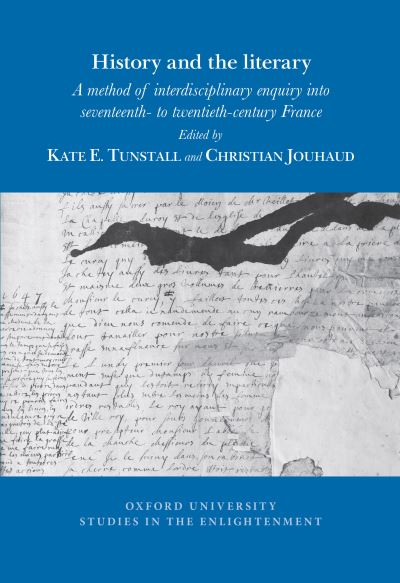
History and the literary: a method of interdisciplinary enquiry into seventeenth- to twentieth-century France
Prix : 75£
Présentation
This book makes available in English for the first time the work of the pioneering French interdisciplinary research group, Groupe de Recherche Interdisciplinaire sur l'Histoire du Littéraire, better known as the GRIHL. Founded in 1997 by the historian, Christian Jouhaud, and the sociologist of literature, Alain Viala, the GRIHL's weekly seminar has been the crucible for the careers of a whole generation of scholars, working on social and political phenomenon of what it terms 'the literary' from the seventeenth to the twentieth centuries, primarily but not exclusively in France, and pioneering an interdisciplinary perspective.The brainchild of Alain Viala, who died in 2021 and to whom it pays tribute, the book combines methodological position pieces and case studies, work done both individually and collectively as a seminar. The Introduction (Kate Tunstall and Christian Jouhaud) situates the GRIHL in the intellectual and institutional landscape and explains what is meant by 'the literary' (as distinct from 'literature'). Three powerful pieces on method - 'Opening Moves' - set out why the GRIHL approaches 'writings' rather than 'texts' and what happens when writing is viewed, as it is by the GRIHL, as a social act (Alain Cantillon, Laurence Giavarini, Dinah Ribard, Nicolas Schapira); what happens when place is viewed not as site but as situation (Mathilde Bombart and Alain Cantillon), and a publication not as an object but as an action (Christian Jouhaud and Alain Viala). The GRIHL's deep interdisciplinarity is evident in the two sets of case studies - 'Three Things to Think With', which includes urban riots (Nicolas Schapira), the literary canon (Laurence Gavarini), libertines and heretics (Sophie Houdard and Jean-Pierre Cavaillé) - and 'Seeing the Past', which deals with Romantic ruins (Judith Lyon-Caen), historical amnesia in Simenon (Christian Jouhaud), and the many figures of Watteau (Alain Viala). Together, these essays make clear what is truly distinctive about the GRIHL's approach. In critical conversation with J. L. Austin, Foucault, de Certeau, and others, including themselves, and with disciplines such as the history of the book and cultural studies, the GRIHL brings into view the many acts of writing that created, sustain - and block - our knowledge of the past.
4e d e couverture en français :
Ce livre rend disponible en anglais pour la première fois les travaux du groupe de recherche interdisciplinaire français pionnier, le Groupe de Recherche Interdisciplinaire sur l'Histoire du Littéraire, mieux connu sous le nom de GRIHL. Fondé en 1997 par l'historien Christian Jouhaud et le sociologue de la littérature Alain Viala, le séminaire hebdomadaire du GRIHL a été le creuset du parcours de toute une génération de chercheurs travaillant sur les phénomènes sociaux et politiques de ce qu'il appelle « le monde littéraire ». » du XVIIe au XXe siècle, principalement mais pas exclusivement en France, et pionnier dans une perspective interdisciplinaire. L'idée d'Alain Viala, décédé en 2021 et à qui il rend hommage, l'ouvrage mêle prises de position méthodologiques et études de cas, travaux réalisés aussi bien individuellement que collectivement sous forme de séminaire.
L'introduction (Kate Tunstall et Christian Jouhaud) situe le GRIHL dans le paysage intellectuel et institutionnel et explique ce que l'on entend par « littéraire » (par opposition à « littérature »). Trois articles puissants sur la méthode - « Opening Moves » - exposent pourquoi le GRIHL aborde les « écrits » plutôt que les « textes » et ce qui se passe lorsque l'écriture est considérée, comme c'est le cas par le GRIHL, comme un acte social (Alain Cantillon, Laurence Giavarini , Dinah Ribard, Nicolas Schapira) ; que se passe-t-il lorsque le lieu est envisagé non comme site mais comme situation (Mathilde Bombart et Alain Cantillon), et une publication non comme objet mais comme action (Christian Jouhaud et Alain Viala).
La profonde interdisciplinarité du GRIHL est évidente dans les deux séries d'études de cas - « Trois choses avec lesquelles penser », qui comprend les émeutes urbaines (Nicolas Schapira), le canon littéraire (Laurence Gavarini), les libertins et les hérétiques (Sophie Houdard et Jean-Pierre Cavaillé). ) - et « Voir le passé », qui traite des ruines romantiques (Judith Lyon-Caen), de l'amnésie historique chez Simenon (Christian Jouhaud), et les nombreuses figures de Watteau (Alain Viala). Ensemble, ces essais mettent en évidence ce qui distingue véritablement l'approche du GRIHL. Dans une conversation critique avec J. L. Austin, Foucault, de Certeau et d'autres, y compris eux-mêmes, et avec des disciplines telles que l'histoire du livre et les études culturelles, le GRIHL met en lumière les nombreux actes d'écriture qui ont créé, soutenu - et bloqué - notre connaissance du passé.
Pour citer ce document
,URL : https://crh.ehess.fr:443/index.php?9852.


EHESS-CNRS
CRH (UMR 8558)
54, boulevard Raspail
75006 Paris
Tél. : +33 (0)1 49 54 24 42
Direction du CRH :
Contact Presse : presse@ehess.fr
Dernière modification :
18/11/2026