
Enseignants invités (2017-2027) |
Enseignants invités en 2025
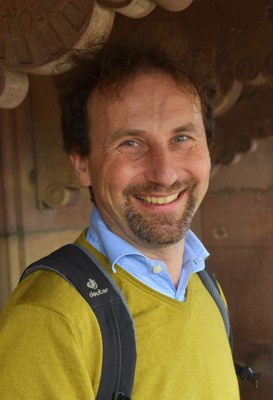
Gerald Schwedler
Coordonnées professionnelles
Christian-Albrechts-Universität zu Kiel
Dpt Economic and Social History
Leibnizstraße, 8
24118 Kiel
Allemagne
Présentation
Gerald Schwedler, invité à l'EHESS par Béatrice Delaurenti (AHLoMA), a étudié l'histoire, les sciences historiques auxiliaires, l'anglais et la philosophie aux universités de Salzbourg, Oxford, Rome et Heidelberg. En 2006, il a obtenu son doctorat à l'université de Heidelberg avec la thèse « Herrschertreffen des Spätmittelalters ». Il a terminé sa thèse d'habilitation à l'Université de Zurich en 2016 sur le thème « Vergessen, Verändern, Verschweigen und damnatio memoriae im frühen Mittelalter ». Il a enseigné aux universités de Zurich, Constance et Heidelberg. Depuis 2018, il est professeur titulaire d'histoire du Moyen Âge tardif et d'histoire économique et sociale à l'université de Kiel. Il a dirigé récemment deux ouvrages : A Cultural History of Memory, vol. 2: In the Middle Ages (London, Bloomsbury, 2021) et avec Sebastian Scholz, Creative Selection between Emending and Forming Medieval Memory (Berlin, Boston: De Gruyter, 2022) et de nombreux articles dont le dernier sur « L'oubli au Moyen Âge. Sélection, transformation et rejet du passé », dans Noëlle-Laetitia Perret, Hans-Joachim Schmidt (dir.), L’oubli collectif au Moyen Âge. Un autre processus constitutif de la cohésion sociale / Memories Lost in the Middle Ages. Collective Forgetting as an Alternative Procedure of Social Cohesion (Brepols, 2023)
Conférences
Dans le cadre du séminaire de Béatrice Delaurenti, L’oubli au Moyen Âge
Obliv! And why the imperative to forget was not used in the Middle Ages. An Introduction to the Field of Oblivion Studies
- Vendredi 10 janvier 2025 de 14h à 16h
- EHESS (Salle A651, 6e étage)
54, boulevard Raspail, 75006 Paris
The first paper will begin with a short introduction into memory and forgetting in Antique thought. Cicero and the Rhetorica ad Herennium saw memory as a primordial capacity for delivering speeches. Only in the Middle Ages a perception of oblivion as counterpart of memory with positive traits began to be reflected. To demonstrate this, we will analyse the main pillars of medieval intellectual history on oblivion as well as some less known authors and their divergent opinions. The paper will conclude with a brief survey of the medieval amnesic culture in practice in the fields of court, monastery and city.
Dans le cadre du séminaire de Béatrice Delaurenti, Vincent Debiais et Pierre Monnet, Histoire intellectuelle et sociale du Moyen Âge,
Administrative Oblivion. Bureaucracy and its professional loss of knowledge in late medieval towns
- Mercredi 15 janvier 2025 de 16h30 à 18h30
- Campus Condorcet - Bâtiment EHESS (Salle 25-A)
2, cours des Humanités 93300 Aubervilliers
The second paper deals with medieval town administrations. The Middle Ages saw the development of modern bureaucratic culture in central as well as local governments. Systems of entangled administrations and the professionalization of writing and record-keeping brought about an enormous flood of paper towards the late Middle Ages. The systems approach of Niklas Luhmann lets us understand how institutional obliteration went hand in hand with the basic differentiation of administration.
Dans le cadre du séminaire de Nicolas Weill-Parot, Histoire des sciences dans l’Occident médiéval,
Homo censurans: Papal and Imperial Politics of Authoritative Readings of the Past
- Mardi 21 janvier 2025 de 18h à 20h
- EPHE-Sorbonne - Section des sciences historiques et philologiques
(Escalier E, 1er étage, salle J. Delamarre 059)
17, rue de la Sorbonne 75006 Paris
The third paper asks about the political strategies and possibilities to form memory of the past. How did strong institutions such as papacy and the emperors act in order to stabilize and extend their own claims of authority that they structurally base on the past? Here we analyze the communicative and practical options of popes, emperors as well as kings in order to understand transpersonal shaping of the past. Make-forget and damnatio memoriae are part of a wide range of political communicative strategies.
Dans le cadre du séminaire de Béatrice Delaurenti, L’oubli au Moyen Âge,
“Geschichtsvergessenheit” Historiography and Oblivion in the Middle Ages
- Vendredi 24 janvier 2025 de 14h à 16h
- EHESS (Salle A651, 6e étage)
54, boulevard Raspail 75006 Paris
The fourth paper analyses medieval Historiography over a time of 1000 years and its affirmative or negative uses of the past. What is kept and what is discarded? We will endeavor into different historiographic traditions in order to highlight specifics and general trends. The array will deal with examples from Gregory of Tours until post reformation authors in the 1540s.
Accueil et durée du séjour
-
Invité à l'EHESS par Béatrice Delaurenti (AHLoMA)
-
Janvier 2025 (1 mois)


EHESS-CNRS
CRH (UMR 8558)
54, boulevard Raspail
75006 Paris
Tél. : +33 (0)1 49 54 24 42
Direction du CRH :
Contact Presse : presse@ehess.fr
Dernière modification :
18/11/2026