
2024 |
Novembre 2024
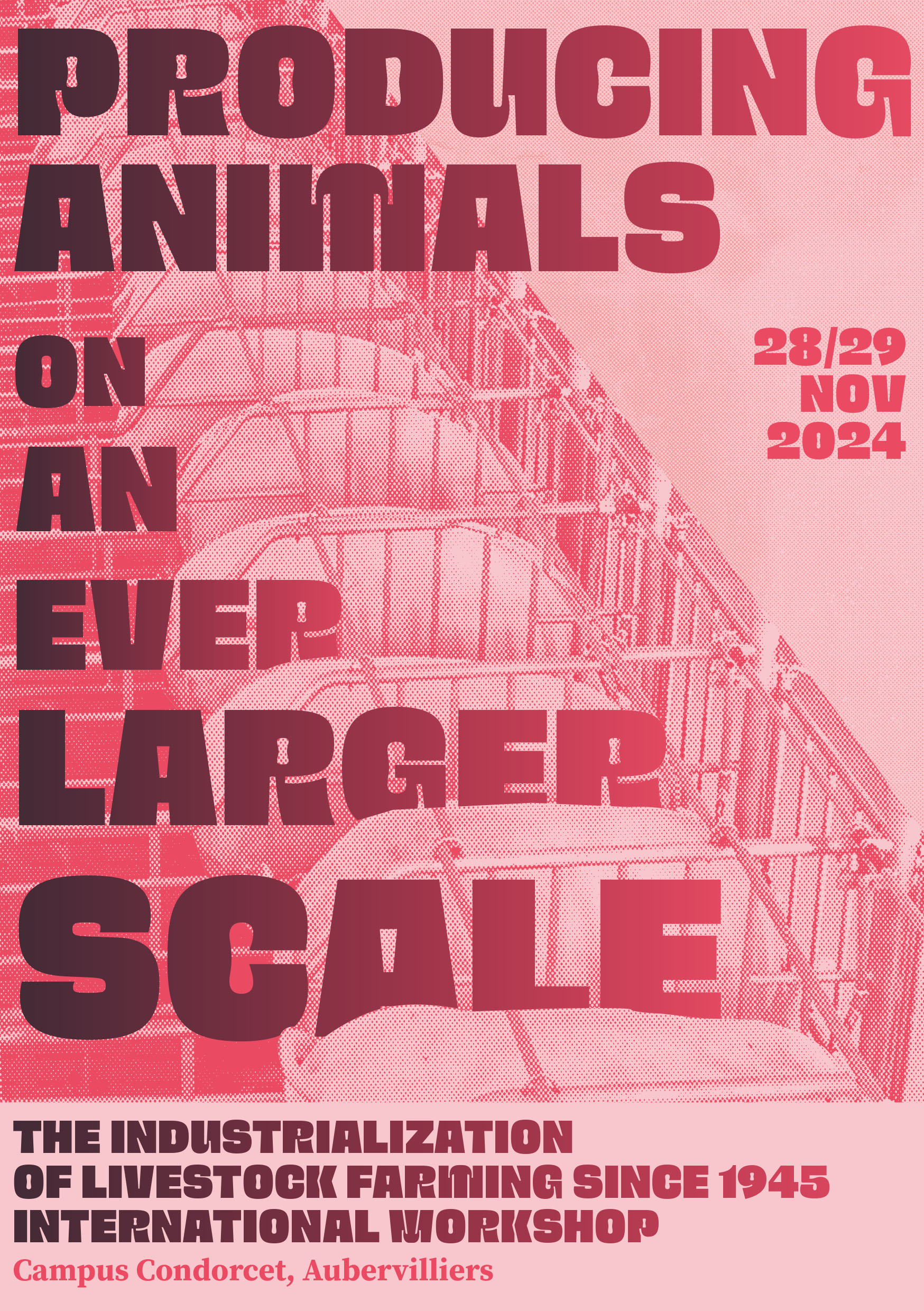
Producing animals on an ever-larger scale. The industrialization of livestock farming since 1945
28 et 29 novembre 2024 - Workshop
Présentation
Since 1945, industrial farming has seen significant growth worldwide, with the concentration of livestock farming sites, the standardization and confinement of animals, the heavy reliance on inputs, etc. Farms are just the tip of the iceberg. Intensive cultivation of animal feeds, agri-supply industries, traders and banks, not to mention agricultural organizations and advisory bodies offering technical and scientific support, have all grown at the same time.
These players now form a powerful agro-industrial system, the purpose of which is to produce ever greater quantities of animal raw materials at the lowest possible cost. While this model was severely criticized in the 1960s, this criticism has since intensified. It condemns the negative consequences of this agro-industrial system, for its impact not only on the environment, but also on human health and on the living conditions of ani- mals. The aim of this workshop is to bring together academics in social sciences to try to gain an overall understanding of the logics that underpin the creation and maintenance of this agro-industrial system on a national and international scale, despite all the criticism.
The workshop, organized by Delphine Berdah (Université Paris-Saclay, Amagri), Marc-Olivier Déplaude (Université Paris-Dauphine, IRISSO), Nicolas Fortané (Université Paris-Dauphine, IRISSO) and Clémence Gadenne-Rosfelder (EHESS, CRH), will examine the irreversible nature of the industrialization of livestock farming processes and the world views that accompany them. It will the- refore examine agricultural production policies and market regulations in different countries; corporate economic strategies that frame breeders’ practices; the types of knowledge and techniques produced and called upon as part of these processes of intensification.The workshop will pay particular attention to the very mate- riality of the industrialization process (buildings, inputs, biochemical and financial flows, paperwork…)
Depuis 1945, l'agriculture industrielle a connu un développement important dans le monde entier : concentration des sites d'élevage, standardisation et confinement des animaux, recours massif aux intrants, etc. Les exploitations agricoles ne sont que la partie émergée de l'iceberg. Les exploitations agricoles ne sont que la partie émergée de l'iceberg. Les cultures intensives d'aliments pour animaux, les industries d'agrofourniture, les négociants et les banques, sans oublier les organisations agricoles et les organismes de conseil offrant un appui technique et scientifique, se sont développés en même temps.
Ces acteurs forment aujourd'hui un puissant système agro-industriel dont l'objectif est de produire toujours plus de matières premières animales au moindre coût. Si ce modèle a été sévèrement critiqué dans les années 1960, cette critique s'est intensifiée depuis. Elle dénonce les conséquences négatives de ce système agro-industriel, pour son impact non seulement sur l'environnement, mais aussi sur la santé humaine et sur les conditions de vie des animaux. L'objectif de cet atelier est de réunir des universitaires en sciences sociales pour tenter de comprendre les logiques qui sous-tendent la création et le maintien de ce système agro-industriel à l'échelle nationale et internationale, malgré toutes les critiques.
Le workshop, organisé par Delphine Berdah (Université Paris-Saclay, Amagri), Marc-Olivier Déplaude (Université Paris-Dauphine, IRISSO), Nicolas Fortané (Université Paris-Dauphine, IRISSO) et Clémence Gadenne-Rosfelder (EHESS, CRH), s'interrogera sur le caractère irréversible de l'industrialisation des processus d'élevage et des visions du monde qui l'accompagnent. Il s'agira donc d'examiner les politiques de production agricole et les régulations des marchés dans différents pays ; les stratégies économiques des entreprises qui encadrent les pratiques des éleveurs ; les types de savoirs et de techniques produits et sollicités dans le cadre de ces processus d'intensification... L'atelier portera une attention particulière à la matérialité même du processus d'industrialisation (bâtiments, intrants, flux biochimiques et financiers, paperasserie...).
Avec le soutien de IFRIS (Institut Francilien Recherche Innovation Société), the Graduate School Humanités et Sciences du Patrimoine Paris Saclay and the IRISSO social science laboratory
Le workshop est ouvert au public. Si vous souhaitez y assister, vous devez vous inscrire avant le 18 novembre prochain à l’adresse suivante : https://form.jotform.com/242733672804055
Programme
Lieu
Attention, changement de lieu en raison de l’affluence ! Le workshop aura lieu à :
Université Paris-Dauphine (Salle A709)
Place Maréchal Lattre de Tassigny
75016 Paris
Document(s) à télécharger
Pour citer ce document
,URL : https://crh.ehess.fr:443/index.php?9648.


EHESS-CNRS
CRH (UMR 8558)
54, boulevard Raspail
75006 Paris
Tél. : +33 (0)1 49 54 24 42
Direction du CRH :
Contact Presse : presse@ehess.fr
Dernière modification :
18/11/2026