
2015 |
Février 2015
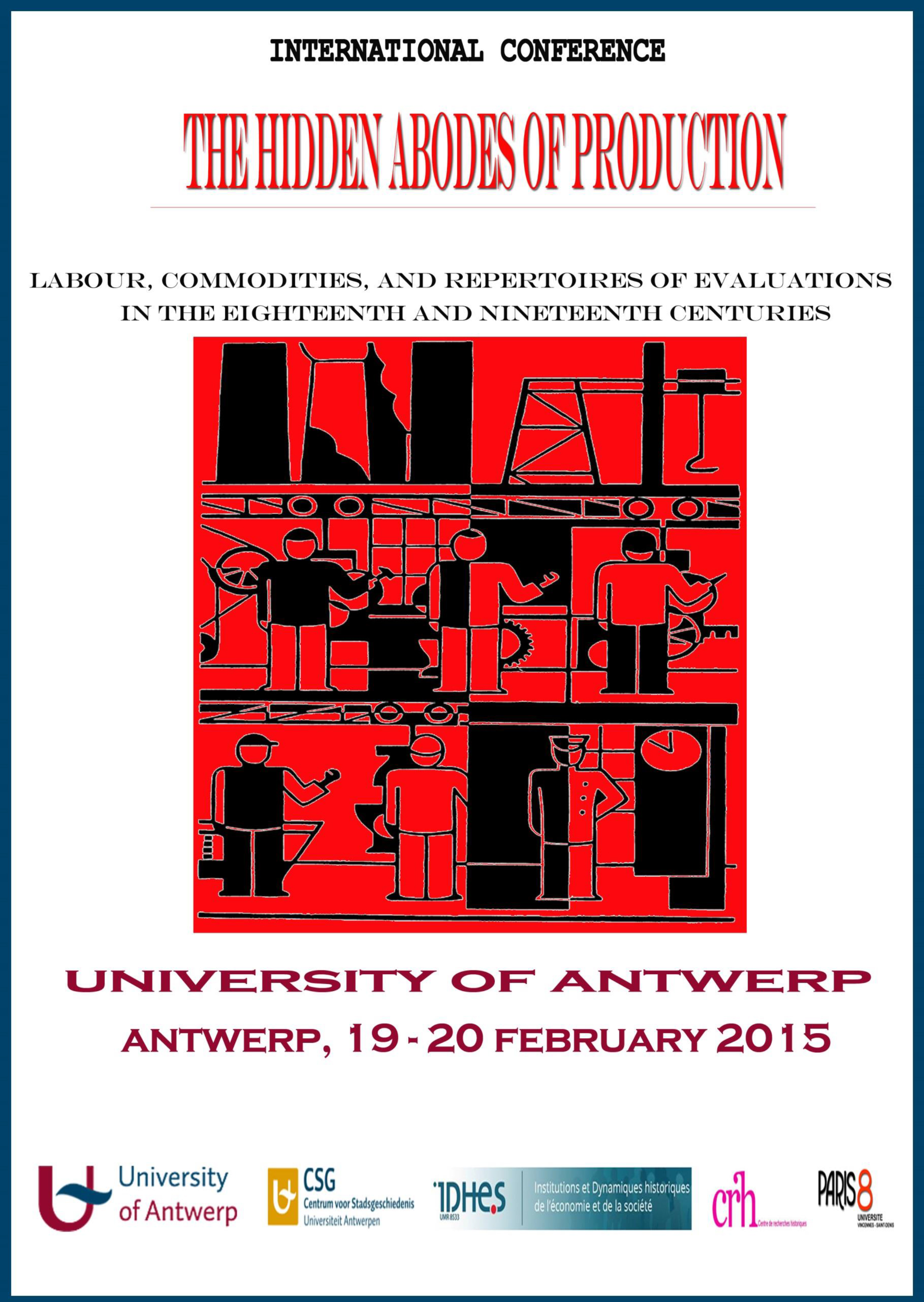
The Hidden Abodes of Production Labour. Commodities and Repertories of Evaluation in the European Eignteenth and Nineteenth Centuries
19 et 20 février - Colloque international
Présentation
Indifference towards any specific kind of labour presupposes a very developed totality of real kinds of labour, of which no single one is any longer predominant. As a rule, the most general abstractions arise only in the midst of the richest possible concrete development, where one thing appears as common to many, to all. – Karl Marx Research and d ebate on workers’ alienation and estrangement during the industrial revolutions has in its heydays in the 1970s and 1980s predominantly focused on technological, organizational and managerial transformations. From a Marxist point of view, the loss of contr ol over the means of production and the division of labour remained the fulcrum around which alienation could be explained in a setting of disciplinary practises and deskilling processes. Harry Braverman drew on his long experiences as a factory worker to explain the long - term tendency of homogenisation of labour in the execution of industrial production. His work Labor and Monopoly Capital (1974) caused heated debates among labour historians, political economists and sociologists. Subsequently, discussions during the ‘cultural turn’ have helped to appreciate the importance and relative autonomy of perceptions of and discourses on labour - whether from outside or from the workers themselves. E.P. Thompson brought the workers’ agency in the production process to light, and emphasized the importance of extra - economic elements in the transformation of concrete labour into labour power – i.e., moral conventions, social status, community ties. Nonetheless, theoretical debates on alienation and commodity fetishism notwithstanding, historians have refrained from examining the practical and at the same time imagined and discursive connections which artisans and workers forged with raw material and the products of their labour. How did the relationship of artisans and workers with their materials and products change during periods of economic transformation? The organisers of this conference intend to enter that terra incognita by studying the importance of cultural practices and repertoires of evaluation in material pr ocesses of production and the construction of product value. To that end, labour will be related to every day practices on the shop floor, political discourses on labour skills and product values, the changing conditions of the workplace, and changing rela tions, practices and sources of power. This conference attempts to adopt a comparative angle between European regions. Doing so, this angle can promote further de - limitations of heterodox, integrative approaches:
-
The perception of labour skills and the ass essment and construction of product values;
-
The repertoires of evaluation concerning the relation between labour and the exchangeable commodity;
-
Different forms of alienation and microphysical relations of power and conventions in the putting - out networks, manufactures and factories during the eighteenth and nineteenth centuries;
-
Continuities and changes in the political discourse on labour processes and institutional reforms.
Programme
Lieu
Université d'Anvers
Prinsstraat 13,
2000 Anvers
Belgique
Document(s) à télécharger
Pour citer ce document
,URL : https://crh.ehess.fr:443/index.php?4359.


EHESS-CNRS
CRH (UMR 8558)
54, boulevard Raspail
75006 Paris
Tél. : +33 (0)1 49 54 24 42
Direction du CRH :
Contact Presse : presse@ehess.fr
Dernière modification :
18/11/2026