
2013-2014 |
Novembre 2013
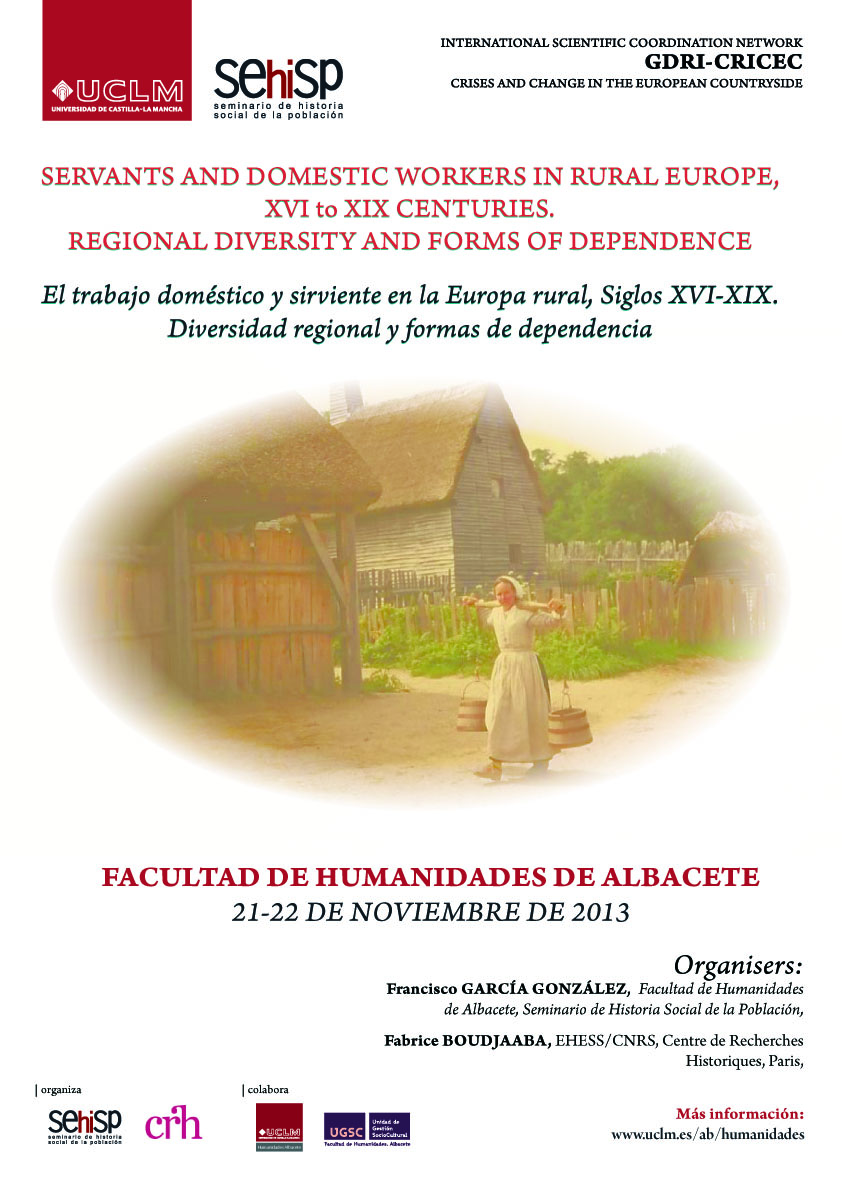
Servants and domestic workers in rural Europe, 16-19th centuries. Regional diversity and forms of dependence
21-22 novembre
Rural history has traditionally confronted two models of organizing agricultural production. On the one hand the family farm, very important in terms of productivity and ability to integrate innovations. On the other hand, the large capitalist holdings, based on waged labour. Examples of these two productive models are the English landholding, supported by wage labour, and the family farms of Southern Europe, which have survived until the twentieth century. Yet this dualistic approach, linked to the debate on the modernization of agricultural production and its transition to capitalism, fails to account for the complex realities of the rural world in the past. After two decades, these models are now under discussion.
Pour citer ce document
,URL : https://crh.ehess.fr:443/index.php?3375.


EHESS-CNRS
CRH (UMR 8558)
54, boulevard Raspail
75006 Paris
Tél. : +33 (0)1 49 54 24 42
Direction du CRH :
Contact Presse : presse@ehess.fr
Dernière modification :
18/11/2026