
2026 |
Mai 2026
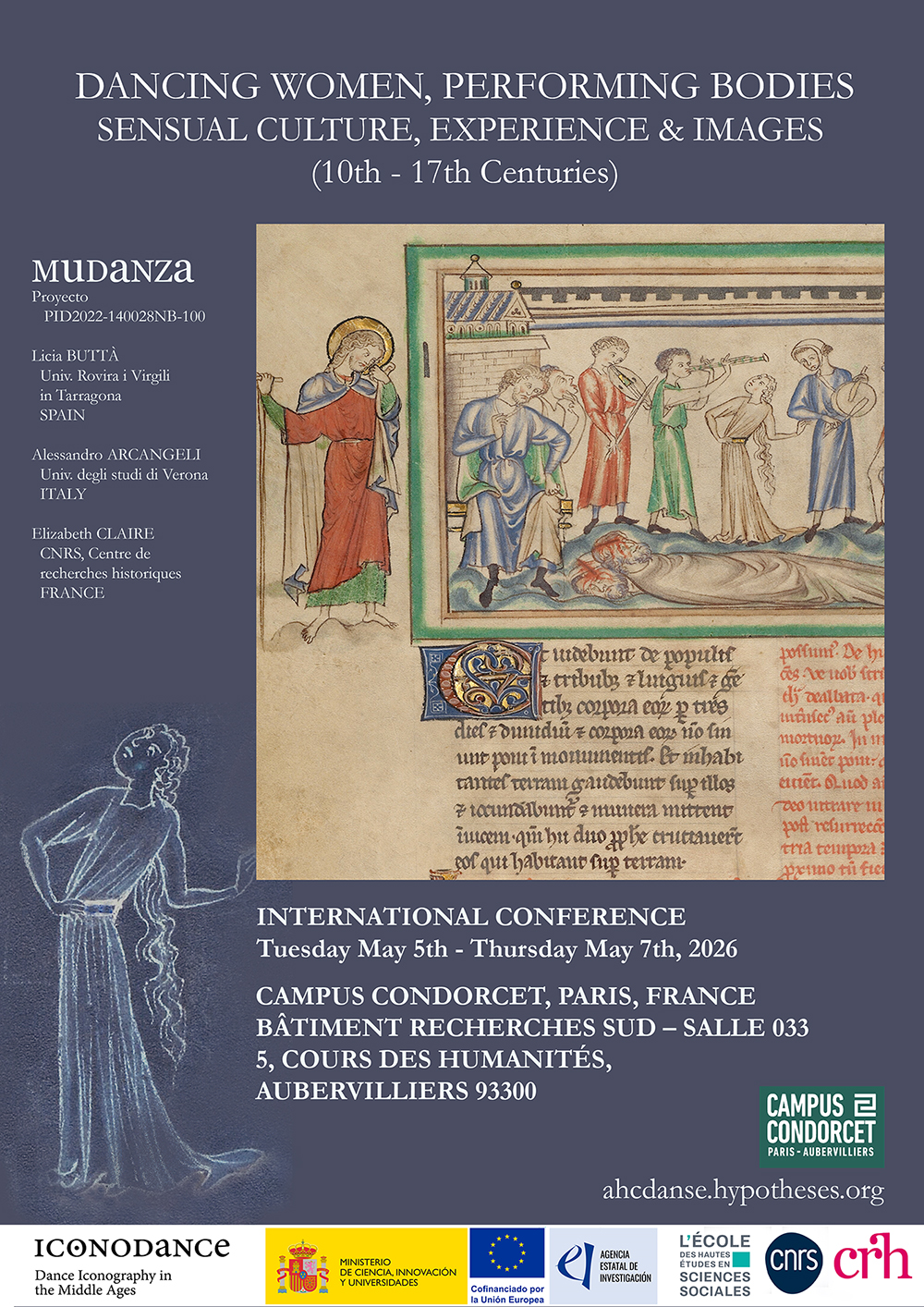
MuDanza (“Dancing Women, Idolatry, and Rites: Visual Culture and Cultural History of Dance in the Long Middle Ages”)
Du 5 au 7 mai 2026 - Colloque international
Présentation
The international research project MuDanza (“Dancing Women, Idolatry, and Rites: Visual Culture and Cultural History of Dance in the Long Middle Ages”) funded by the Spanish Ministry of Science, Innovation, and Universities, focuses on the close relationship established since Antiquity between the female figure and choreographic movements. Regardless of the dance setting, the importance of the dancing female body is evident both in the sacred realm, with dance and celestial choirs exalting and praising God, and in the imagery that stages idolatry, diabolical rites, or the perverse use of the body in earthly performances. As a direct inheritance from pagan cults, the representation of idolatrous acts during the Middle Ages can be contrasted with representations of wild Dionysian cults. In these polarized contexts, women are the absolute protagonists of choreographic acts for much of the Middle Ages and beyond. Interpreted negatively—as in the case of female minstrels, the figure of Salome, or dancing witches—or positively—as in certain sacred figures who, through dance, achieve ecstasy and attain a vision of God—literary, allegorical, and historical female dancers depicted in the source material reveal the medieval conception of the body. Studying this social and anthropological vision of the body-dance pairing in representations featuring female figures in biblical and literary texts, in exempla, as well as biographical and hagiographical accounts of sacred figures and dances performed within convents, raises the historical question of techniques of embodiment.
MuDanza’s anthropological approach to the image, along with iconographic analyses of the context in which the dances developed, aids in the investigation of the visual culture of the period under study, while a gender perspective allows for the reconstruction of the image of women as a central element of medieval choreographic narrative. The study unfolds within the field of cultural history and the visual culture of dance in medieval Europe and its enduring influences, aiming to provide a novel perspective on the role of women as dancing bodies, as typological figures in biblical exegesis, and as key elements for exploring the history of emotions, gesture, and the female body in the long Middle Ages, understood, according to Jacques Le Goff, as a period extending beyond the chronological limits imposed by historiographical tradition.
Dance as represented by images and texts in the Middle Ages and the Early Modern period has had remarkable fortune, allowing us to reflect on the role of choreographic images as an ‘Ansatzpunkt’. This concept developed by the German philologist Erich Auerbach can be translated as ‘starting point’ or ‘foothold’ and refers to the role played by certain seemingly marginal aspects of literary production which, nevertheless, constitute ‘footholds’ for exploring specific aspects of cultural history. Adapting this methodological intuition to the discourse on dance allows us to study its representations in a broader framework which, moving away from its possible choreological value, opens the way for understanding them as a starting point for studying the cultural context of dance as a social practice, as a ritual, as a performance that involves both the dancer and the observer in equal measure. The dance image has a performative character as far as it evokes a real praxis, and a mnemonic character, as far as it is an ‘Ansatzpunkt’, which manifests itself with a strong intertextual character. Dance representations, therefore, must be understood first and foremost through their relationship to social rites, sacred and secular narratives, and the experience of performance in its material and sensory aspects. The lenses of the history of experience, as it has recently emerged at the crossroads between the history of emotions and of the senses, may prove a promising perspective if we want to move beyond the limits of the normative literature (whether aesthetic or moral) and approach the meaning dance had at the time for both its participants and spectators.
Dancing Women, Performing Bodies. Sensual Culture, Experience & Images (10th-17th C.) reflects specifically upon the role of the dancing female body in the narrative and visual context of the long Middle Ages and dancing’s impact on sensual culture, while tracing the resonance of the choreographic experience in both religious and secular contexts. This research encounter also focuses on the very close relationship that can be established between the female figure and choral movements. Whatever the setting of the dance, the importance of the dancing female body is evident both in the sacred sphere and in the imaginary realm that stages idolatry, diabolical rites or the perverse use of the body in earthly performances. In these polarized contexts, women are the undisputed protagonists. Whether interpreted negatively or positively, literary, allegorical and even historical female dancers reflect medieval conceptions of the body, performing the social and anthropological vision of a dancing that deeply involves the emotions and the senses.
Direction
- Licia Buttà, Universitat Rovira i Virgili in Tarragona, Spain - porteuse du projet MuDanza
- Alessandro Arcangeli, Università degli studi di Verona, Italy
- Elizabeth Claire, Cnrs, Centre de recherches historiques (umr 8558, Ehess-Cnrs), France
Conference Manager
- Giulia di Pierro, Universitat Rovira i Virgili in Tarragona, Spain
Scientific Committee
- Angela Bellia, Università degli Studi di Palermo, Italy
- Pierre-Olivier Dittmar, Ehess, Centre de recherches historiques, France
- Elina Gertsman, Case Western Reserve University, USA
- Meritxell Simo, Universitat de Barcelona, Spain
- Donatella Tronca, Alma Mater Studiorum, Università di Bologna, Italy
- Maria del Mar Valls Fusté, Universitat Autonoma de Barcelona, Spain
Programme
Lieu
Campus Condorcet
Bâtiment de Recherches Sud (Salle 0.33)
5, Cours des Humanités
93300 Aubervilliers
Document(s) à télécharger
Pour citer ce document
,URL : https://crh.ehess.fr:443/index.php?11073.


EHESS-CNRS
CRH (UMR 8558)
54, boulevard Raspail
75006 Paris
Tél. : +33 (0)1 49 54 24 42
Direction du CRH :
Contact Presse : presse@ehess.fr
Dernière modification :
18/11/2026