
Parutions (2017-2027) |
Parutions 2025
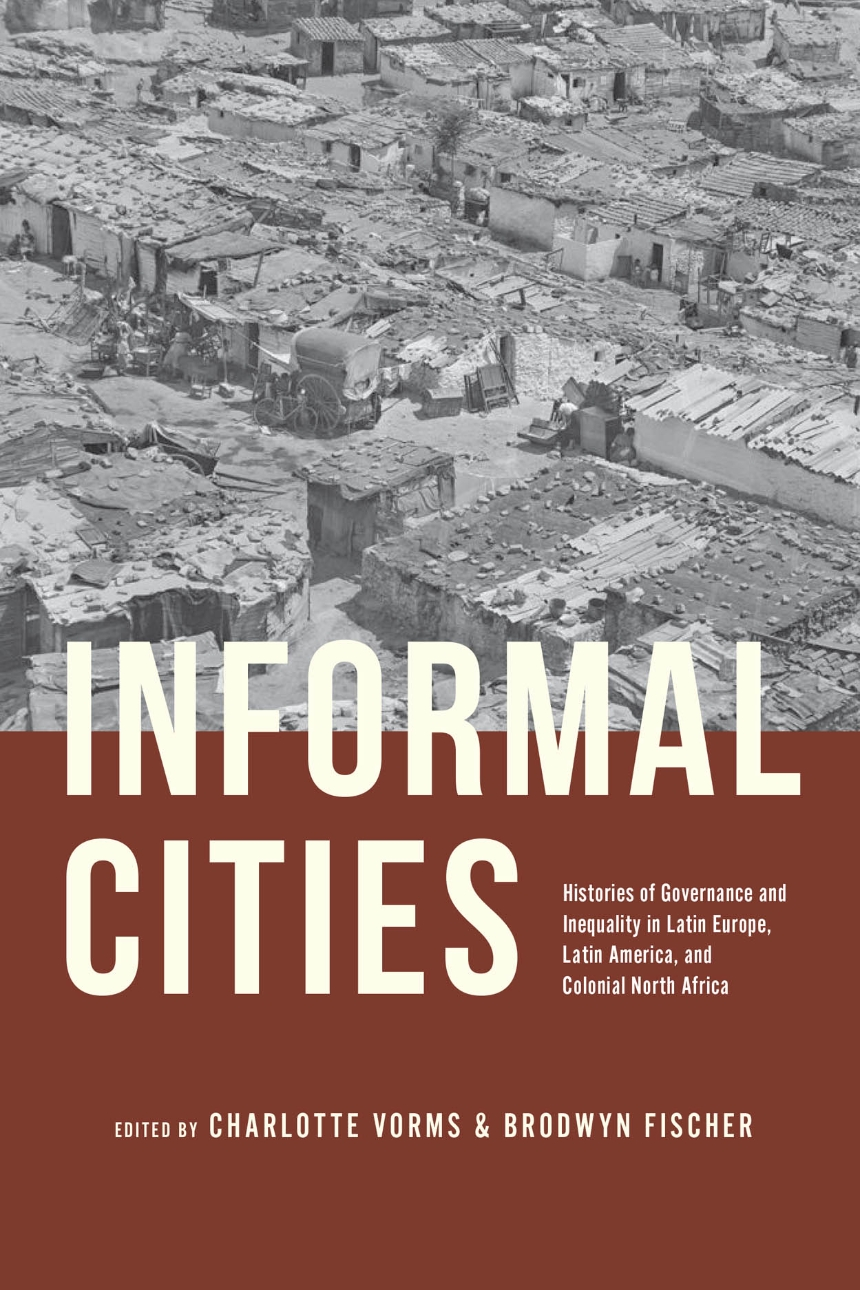
Informal Cities
Histories of Governance and Inequality in Latin Europe, Latin America, and Colonial North Africa
Prix : 35$
Présentation
An empirically rich reconstruction of how informality became an intrinsic part of urban life across three continents.
Over a quarter of the world’s urban population lives in informal settlements. While informality as a concept has been widely debated, we still know very little about the phenomenon’s urban history or how that history has shaped the evolution of world cities. Spotlighting the historical processes that have created and sustained urban informality for more than a century, editors Charlotte Vorms and Brodwyn Fischer and this volume’s contributors reveal informality as an intrinsic feature of urbanity, shaping not only cities across the globe but also deeper processes of state formation, socioeconomic stratification, and political struggle.
The volume brings together case studies spanning more than a hundred years, drawn from Latin America (Brazil, Chile, Venezuela, and Mexico), Northern Africa (Morocco and Algeria), and Latin Europe (France, Spain, and Italy). Together, they show that informality is neither a contemporary crisis nor a predicament unique to the Global South. Topics include the origins of informal settlements and their relationship with law and institutional power; grassroots efforts to legitimize shantytown communities; mass social movements for rights to the city; the role that shantytown removal campaigns played in populist politics, fascism, and colonialism; and the ways that informality perpetuated racial and ethnic inequalities.
Traduction française :
Plus d'un quart de la population urbaine mondiale vit dans des quartiers informels. Si la notion d'informalité a fait l'objet de nombreux débats, nous en savons encore très peu sur l'histoire urbaine de ce phénomène ou sur la manière dont cette histoire a façonné l'évolution des villes du monde. Mettant en lumière les processus historiques qui ont créé et entretenu l'informalité urbaine pendant plus d'un siècle, Charlotte Vorms, Brodwyn Fischer et l'ensemble des contributeurs et contributrices de cet ouvrage montrent que l'informalité est un élément intrinsèque de l'urbanité. Celui-ci façonne non seulement les villes à travers le monde, mais participent aussi des processus de fond de formation des États, de stratification socio-économique et de lutte politique.
Cet ouvrage rassemble des études de cas couvrant plus d'un siècle et un espace allant de l'Amérique latine (Brésil, Chili, Venezuela et Mexique), à l'Afrique du Nord (Maroc et Algérie) et à l'Europe latine (France, Espagne et Italie), montrant que l'informalité n'est ni une crise contemporaine ni une situation propre aux pays du Sud. L'ouvrage traite des origines des quartiers informels et de leur relation avec le droit et les institutions, des efforts populaires pour légitimer les communautés des bidonvilles, des mouvements sociaux de masse pour les droits à la ville, du rôle que les politiques de démolition des bidonvilles ont joué dans la politique populiste, le fascisme et le colonialisme, ainsi que des façons dont l'informalité a perpétué les inégalités raciales et ethniques. Informal Cities est un guide indispensable pour comprendre la complexité de l'informalité urbaine sous ses multiples facettes historiques.
Sommaire
Introduction: Informal Urbanism as History. Brodwyn Fischer and Charlotte Vorms
Part I: Law, Governance, and the Invention of Informality
1. Four Regimes of Informality: Legal Practices and Revolutionary Politics in Twentieth-Century Mexico City. Antonio Azuela and Emilio de Antuñano
2. From Insalubrious Housing to Unauthorized Neighborhoods: The Conceptualization of Urban Informality in Italy, 1880s-1960s. Francesco Bartolini
3. A Century of Governing with Informal Urbanization in Madrid, 1860s–1960s. Charlotte Vorms
Part II. Urban Informality and Political Struggle
4. “The Order Came from Above”: The Political and Ideological Foundations of Fascism’s Struggle against the Baracche in Rome. Luciano Villani
5. Carioca Favelas and the Catholic Church after World War II: The Case of the Fundação Leão XIII’s Interventions in Praia do Pinto. Rafael Soares Gonçalves
6. Democratizing the Republic by Instituting the Informal: Barrio Irregularity in Caracas and Venezuelan Democratization, 1941-1964. Serge Ollivier
7. The Invention of the Toma: Informality and Mobilization in Santiago de Chile, 1945-1957. Emanuel Giannotti and Boris Cofré Schmeisser
Part III: Race and Colonial Domination
8. Informality, Racialized Governance, and the Cidade Negra in Modern Brazil. Brodwyn Fischer
9. Bidonvilles in France: A New Term for an Old Phenomenon? Françoise de Barros
10. Urban Risk? Constructing Shantytowns as a Problem of Colonial Governance in Algiers and Casablanca, 1919-1962. Jim House
ISBN : 978-0226836003
Fiche éditeur : https://press.uchicago.edu/ucp/books/book/chicago/I/bo249481119.html
Pour citer ce document
,URL : https://crh.ehess.fr:443/index.php?10569.


EHESS-CNRS
CRH (UMR 8558)
54, boulevard Raspail
75006 Paris
Tél. : +33 (0)1 49 54 24 42
Direction du CRH :
Contact Presse : presse@ehess.fr
Dernière modification :
18/11/2026