Présentation
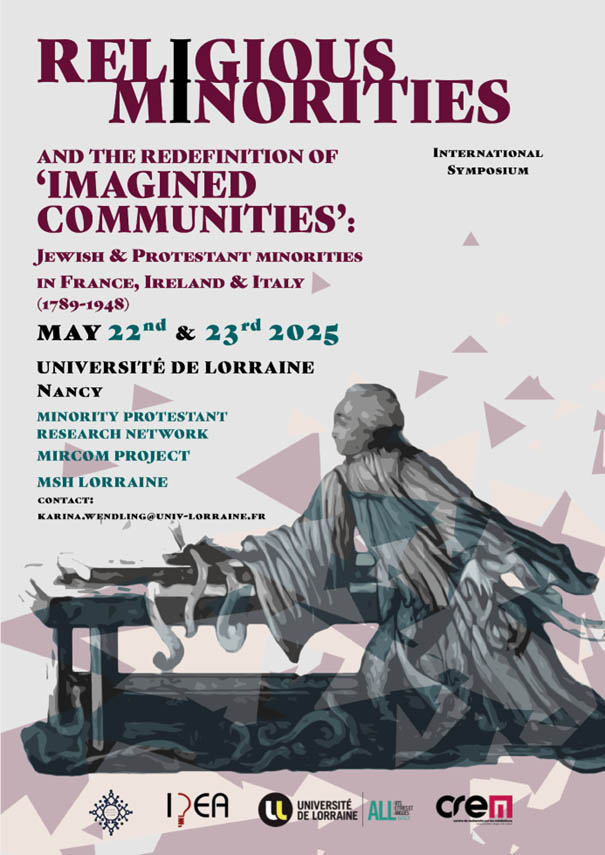
This international and bilingual symposium aims to explore the role of religious minorities, their visibility, and their representation and perception, both internally and externally, in nation-building. As part of the MIRCOM project funded by the MSH Lorraine and coordinated by Karina Bénazech Wendling, this symposium is a preparatory stage for the organisation of an international conference in 2026 and the publication of an edited collection.
Relying on previous studies of the relations between Protestant and Jewish minorities and European nation-states (Cabanel, 2024, 2004; Birnbaum & Katznelson, 1995; Sorkin, 2019; Turner, 2011), and on their role in the emergence of religious freedom, French secularism and religious pluralism, this symposium aims to examine how these minorities, by claiming their part in the construction of the Nation, also participated in redefining national identities in France, Ireland and Italy during the period from the late 18th century to the creation of the State of Israel. It invites scholars to go beyond the question of the integration of these minorities, generally considered through the prism of assimilation and homogenisation, by examining how they contributed to the heterogenisation of these ‘imagined communities’ in demanding equal treatment, a central principle of democratic regulation, inspired by the French Declaration of the Rights of Man and of the Citizen (Biagini & Gerstle, 2022). As a result, national identities no longer appear as simple products of a desire for homogenisation, but the fruit of an antagonism between the two processes of homogenisation (a single Nation) and heterogenisation (acceptance of the diversity of its components).
Ce colloque international et bilingue a pour objectif d'explorer le rôle des minorités religieuses, leur visibilité, leur représentation et leur perception, tant à l'intérieur qu'à l'extérieur, dans la construction de la nation. Dans le cadre du projet MIRCOM financé par la MSH Lorraine et coordonné par Karina Bénazech Wendling, ce colloque est une étape préparatoire à l'organisation d'une conférence internationale en 2026 et à la publication d'un recueil.
S'appuyant sur les études antérieures des relations entre les minorités protestantes et juives et les États-nations européens (Cabanel, 2024, 2004 ; Birnbaum & Katznelson, 1995 ; Sorkin, 2019 ; Turner, 2011), et sur leur rôle dans l'émergence de la liberté religieuse, de la laïcité française et du pluralisme religieux, ce colloque vise à examiner comment ces minorités, en revendiquant leur part dans la construction de la Nation, ont également participé à la redéfinition des identités nationales en France, en Irlande et en Italie durant la période allant de la fin du XVIIIe siècle à la création de l'État d'Israël. Il invite à dépasser la question de l'intégration de ces minorités, généralement envisagée à travers le prisme de l'assimilation et de l'homogénéisation, en examinant comment elles ont contribué à l'hétérogénéisation de ces « communautés imaginées » en revendiquant l'égalité de traitement, principe central de la régulation démocratique, inspiré par la Déclaration française des droits de l'homme et du citoyen (Biagini & Gerstle, 2022). Dès lors, les identités nationales n'apparaissent plus comme de simples produits d'une volonté d'homogénéisation, mais comme le fruit d'un antagonisme entre les deux processus d'homogénéisation (une Nation unique) et d'hétérogénéisation (acceptation de la diversité de ses composantes).
Guest Speakers
Eugenio Biagini, Sidney Sussex College, Cambridge
Patrick Cabanel, École Pratique des Hautes Études / GSRL-CNRS
Davide Mano, École des Hautes Études en Sciences Sociales / CRH
Trisha Oakley-Kessler, Woolf Institute, Cambridge
Scientific Committee :
Eugenio Biagini, Sidney Sussex College, Cambridge
Patrick Cabanel, École Pratique des Hautes Études / GSRL-CNRS
Stéphane Guy, University of Lorraine / IDEA
Julien Léonard, University of Lorraine / CRHUL
Davide Mano, EHESS / CRH
Trisha Oakley-Kessler, Woolf Institute, Cambridge
Laura Popa, Giessen University
Géraldine Vaughan, University of Lille / CECILLE
Partners
Maison des Sciences de l’Homme, Lorraine, GIS EIRE
Minority Protestants Network:
https://minorityprotestants.wordpress.com/
Contact : karina.wendling [a] univ-lorraine.fr