
2025 |
Juin 2025
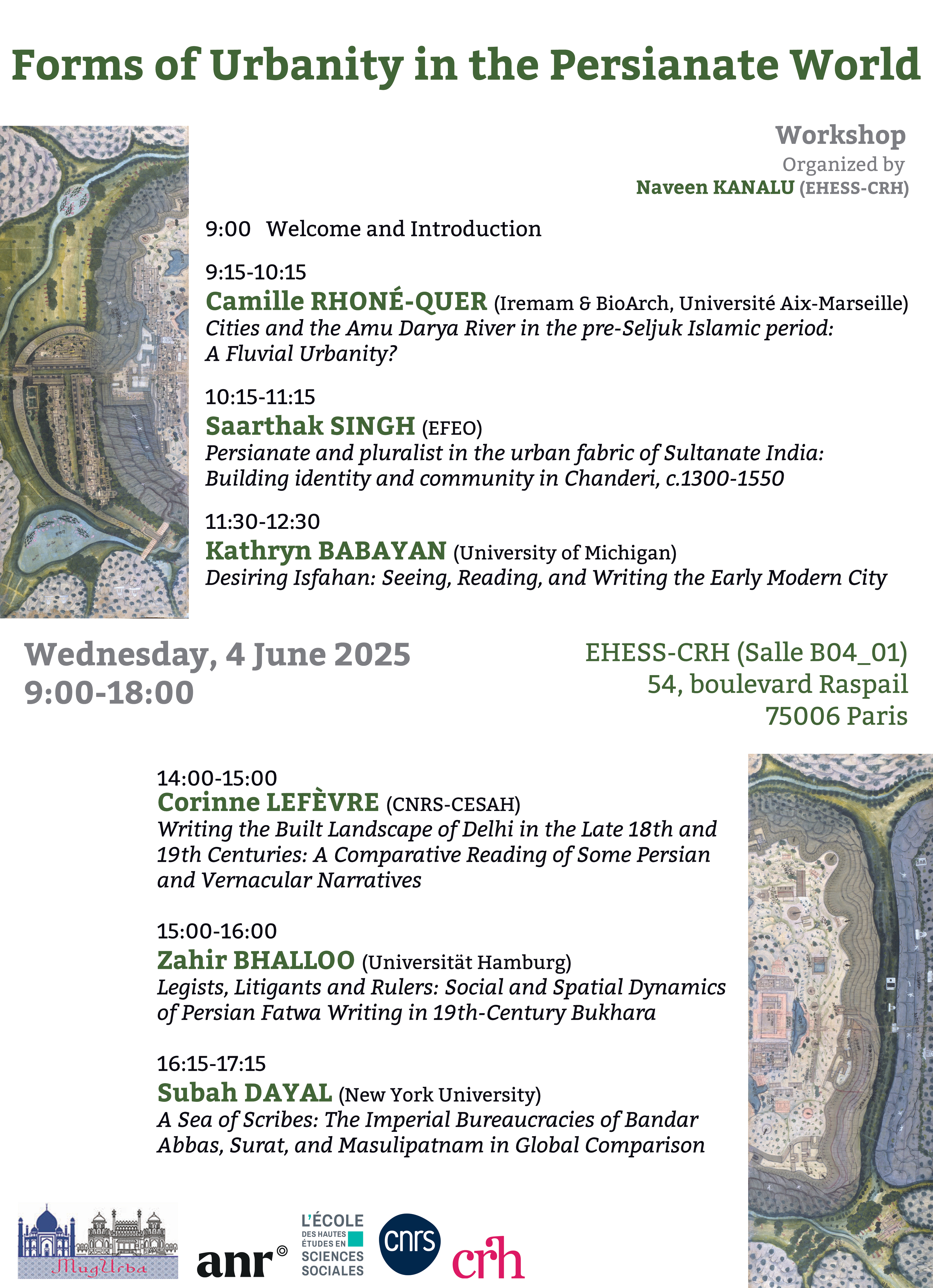
Forms of Urbanity in the Persianate World
Mercredi 4 juin 2025 de 9h à 18h - Workshop
Présentation
Organiser: Naveen Kanalu (EHESS-CRH)
The workshop explores the processes of urbanization and the forms of lived urbanity in the eastern Islamicate world in the medieval and the early modern period. It interrogates the religious, social, economic and cultural dimensions of the urban spaces of Persianate societies in Iran, southern Asia and the Indian Ocean by offering a granular analysis of urban experiences, filtered through a variety of archival, textual, literary and material sources. Through talks on the religious and sacred landscape of urban shrines, commercial and artisan networks as well as imperial mechanisms of governing cities and the social cohabitation of members of different ethnic, religious and caste communities, the workshop maps the dynamic contours of Persianate urbanities in the premodern world.
The workshop engages with a variety of urban relations that were shaped around garrison towns of military contingents, suburban agglomerations, and the rural hinterland. How was city life experienced by diverse social groups such as merchants, poets, scholars and administrators? The workshop will reflect on these issues across a vast space where Persian was the language of elite culture. The workshop also provides an opportunity to compare and contrast the ethnic, social and economic diversities of urban culture. Moreover, it aims to understand how different kinds of cities: imperial capitals, regional centres, religious sites or port cities produced distinct forms of urbanity while also creating inter-urban interlinkages that characterized the Persianate world.
The workshop is sponsored by the ANR project MugUrba: “The Bureaucratic Rhythms of Imperial Urbanity: Law, Property and Public Life in Mughal South Asia, c. 1650–1750”.
La journée d'études examine les processus d'urbanisation et les formes d'urbanité vécue dans le monde musulman oriental aux époques médiévale et moderne. Elle s'intéresse aux dimensions religieuses, sociales, économiques et culturelles des espaces urbains de sociétés persanophones en Iran, en Asie du Sud et dans l'océan Indien, et propose une analyse fine des expériences urbaines, filtrée par une variété de sources documentaires, textuelles, littéraires et matérielles. À travers des discussions sur le paysage religieux et sacré des sanctuaires urbains, les réseaux commerciaux et artisanaux, ainsi que les mécanismes impériaux de gouvernance des villes et la cohabitation sociale des membres de différentes communautés ethniques, religieuses et de castes, la journée interroge les formes d'urbanités persanophones.
Elle s'intéresse également à diverses relations urbaines façonnées autour des villes de garnison, des agglomérations péri-urbaines et de l'arrière-pays rural. Comment la vie urbaine était-elle vécue par divers groupes sociaux tels que les marchands, les poètes, les érudits et les administrateurs ? Elle se penchera sur ces questions dans un vaste espace où le persan était la langue savante. Elle offre également l'occasion de comparer la diversité ethnique, sociale et économique de la culture urbaine. Elle vise également à comprendre comment différents types de villes, telles que les capitales impériales, les centres régionaux, les sites religieux ou les villes portuaires, ont produit des formes distinctes d'urbanité tout en créant des liens interurbains qui ont caractérisé le monde persanophone.
Contact : naveen.kanalu@ehess.fr
Programme
9:00 Welcome and Introduction
9:15-10:15 Camille Rhoné-Quer (Iremam & BioArch, Université Aix-Marseille)
Cities and the Amu Darya River in the pre-Seljuk Islamic period: A Fluvial Urbanity?
10:15-11:15 Saarthak Singh (EFEO)
Persianate and pluralist in the urban fabric of Sultanate India: Building identity and community in Chanderi, c.1300-1550
11:15-11:30 Coffee Break
11:30-12:30 Kathryn Babayan (University of Michigan)
Desiring Isfahan: Seeing, Reading, and Writing the Early Modern City
12:30-14 Lunch
14:00-15:00 Corinne Lefèvre (CNRS, CESAH)
Writing the Built Landscape of Delhi in the Late 18th and 19th Centuries: A Comparative Reading of Some Persian and Vernacular Narratives
15:00-16:00 Zahir Bhalloo (Universität Hamburg)
Legists, Litigants and Rulers: Social and Spatial Dynamics of Persian Fatwa Writing in 19th-Century Bukhara
16:00-16:15 Coffee Break
16:15-17:15 Subah Dayal (New York University)
A Sea of Scribes: The Imperial Bureaucracies of Bandar Abbas, Surat, and Masulipatnam in Global Comparison
General Discussion
Lieu
EHESS
CRH (Salle B04-01, 4e étage)
54, boulevard Raspail
75006 Paris
Document(s) à télécharger
Pour citer ce document
,URL : https://crh.ehess.fr:443/index.php?10278.


EHESS-CNRS
CRH (UMR 8558)
54, boulevard Raspail
75006 Paris
Tél. : +33 (0)1 49 54 24 42
Direction du CRH :
Contact Presse : presse@ehess.fr
Dernière modification :
18/11/2026