
Enseignants invités (2017-2027) |
Enseignants invités en 2025
Kathryn Babayan
Coordonnées professionnelles
University of Michigan
DFepartment of History
College of Literature, Sciences and Arts (LSA)
1029 Tisch Hall
435 S. State St.
Ann Arbor, MI 48109-1003
USA
Présentation
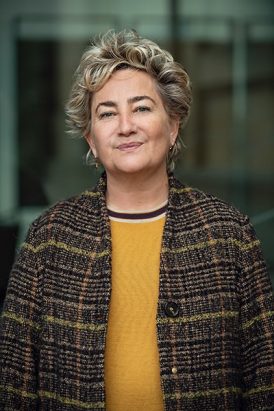
Kathryn Babayan est professeur à l'Université du Michigan, au College of literature, Science and Arts (LSA Hisrory), invitée à l'EHESS par Naveen Kanalu (LaDéHiS-GEHM), dans le cadre du programme de la chaire de l'ISSMM. Kathryn Babayan est une historienne sociale et culturelle du monde persan prémoderne, avec un intérêt particulier pour les études de genre et l'histoire de la sexualité. Elle vient de recevoir une bourse du National Endowment for the Humanities (2024-25) pour son projet actuel intitulé L'Anthologie Persane : Lire le long des marges, qui est une histoire genrée des pratiques de lecture al’époque premoderneen Iran.
Le projet d’anthologie d’Ispahan découle du livre de Babayande 2021 (pour lequel elle a reçu la mention honorable 2022, Fatma Mernissi Book Award, Middle Eastern Studies Association) intitulé La ville comme anthologie : urbanité et érotisme dans l’Ispahan prémoderne (SUP, 2021).
K. Babayan est l'auteur d'un autre livre primé, Mystics, Monarchsand Messiahs:Cultural Landscapes of Early Modern Iran (Cambridge M.A.-Harvard University Press, 2003). Elle a également co-écrit Slaves of the Shah:New Elites of SafaviIran, avec Sussan Babaie, Ina Baghdiantz-McCabe et Massumeh Farhad(Londres : I.B. Tauris, 2004), et a co-édité deux livres,SexualitésIslamique: Traductions à travers le temps et la géographies du désir avec Afsaneh Najmabadi (Cambridge M.A.-Harvard University Press, 2008) et Une Méditerranée arménienne: mots et mondes en mouvement avec Michael Pifer (Cham, Suisse : PalgarveMacmillan, 2018).
Conférences
Dans le cadre du séminaire d'Arnaud Orain, Silvia Sebastiani et Sebastian Veg, Historiographies modernes : histoire, écritures, temporalités
Microhistories of Reading: Anthologies before Print Culture
Print technology arrived in Iran, in full force, in the early twentieth century. Anthologies circulated; they were sold and inherited for more than three centuries and bear the trace of multiple hands and seals, from owners to scribes and friends who inscribed themselves in the margins of folios. They chronicle the continued value and distribution of seventeenth-century anthologies well into the twentieth century. The sustained deployment of anthologies makes them a rich object of study for the history of reading and the circulation of book knowledge. I will focus on a couple of anthologies to do a microstudy on the long durée techniques of reading in Iran.
- Jeudi 15 mai 2025 de 11h à 13h
- EHESS (Salle A04_47)
54, Bld Raspail 75006 Paris
Dans le cadre du séminaire IISMM de Charles Ganier, Denis Hermann et Erdak Kaynar, Autorité et culture politique en Iran qajar et dans l’Empire ottoman (ca. 1780-1920)
Material Sentiments: Gifts of Letters and Paintings in early modern Isfahan
Generated and then collected and assembled in the domestic sphere, gifts of letters and paintings were objects fashioned with the precise intent of traversing the spaces between households. They were assembled in private homes, and ultimately collected in households, but their first-order purpose was to forge affective connections outside the home. My readings of these verbal and visual texts treat the adab of friendship as the epicenter of a praxis of assembly, one that not only draws certain kinds of people together but also one that connects people through objects and to objects.
- Vendredi 16 mai de 10h à 12h
- EHESS-IISMM (Salle B3_18)
54 Bld Raspail 75006 Paris
Dans le cadre du séminaire du Naveen Kanalu, Le sujet de droit en Islam : l’empire moghol et l’Inde
Family Archives: Urban Knowledge and Social History
This lecture explores household anthologies (majmu’a) as an early modern artifact that assembled urban knowledge necessary to live a refined (adab) life in cities like Isfahan, Agra, and Istanbul. Though the habit of anthologizing is a broader phenomenon, Western European commonplace books, manuscript anthologies, and Sammelbände are distinct from the flexible and multifold Persian household anthology. These anthologies, I will demonstrate, are household productions which allow us to read them as family archives. We can, thus, enter the domestic space and learn about family culture and modes of communicating social relations.
- Mercredi 28 mai de 16h30 à 18h30
- Campus Condorcert-Centre de colloques
(Salle 3.07) - Place du Front populaire 93300 Aubervilliers
Dans le cadre du Workshop "Forms of Urbanity in the Persianate World" organisé par Naveen Kanalu
Desiring Isfahan: Seeing, Reading, and Writing the Early Modern City
It is not a given that cities must be represented in writing. Writing the city was an early modern phenomenon in the Islamicate world. We will focus on Safavid literati who admitted the cityscape into writing (shahrashub) to contain it and make it available as an object of exploration. By making a place for the city in writing, I argue that seeing, desiring, and reading became entangled modalities of encounter that allowed residents to experience the city and historians to recognize new forms of sociability.
- Mecredi 4 juin de 11h30 à 12h30
- EHESS (Salle B 4_01)
54, Bld Raspail 75006 Paris
Accueil et durée du séjour
-
Invitée par Naveen Kanalu (LaDéHiS-GEHM)
-
Mai-Juin 2025 (1 mois)


EHESS-CNRS
CRH (UMR 8558)
54, boulevard Raspail
75006 Paris
Tél. : +33 (0)1 49 54 24 42
Direction du CRH :
Contact Presse : presse@ehess.fr
Dernière modification :
18/11/2026