
2025 |
Avril 2025
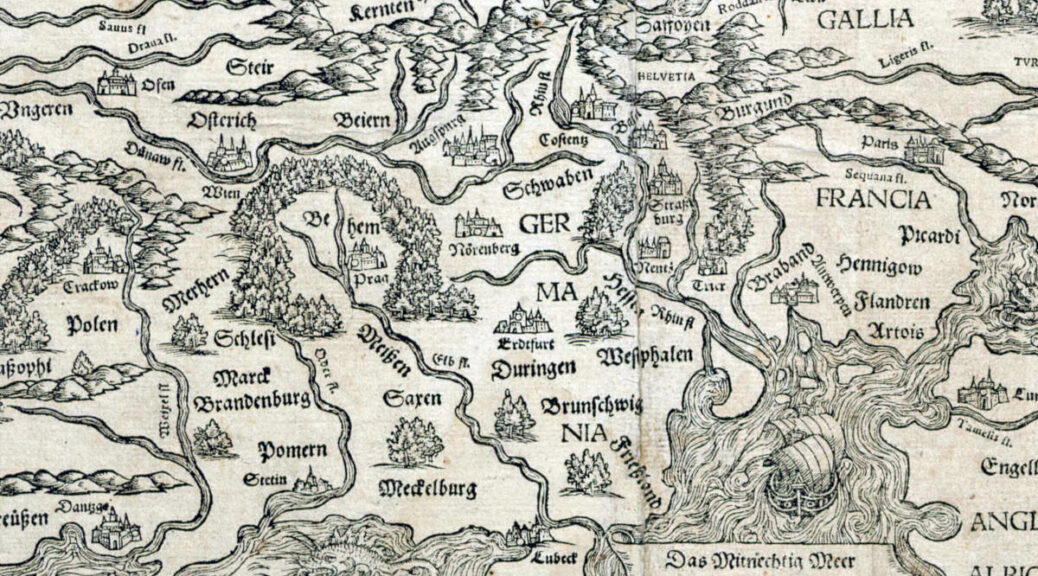
A European Middle Ages. Circulation of Objects, Practices, and Techniques between Central and Western Europe (1000–1600)
Jeudi 24 avril 2025 de 9h30 à 17h30 - Journée d'étude doctorale
Présentation
4e Journée d'étude doctorale organisée par Lise Saussus (EHESS, CRH), Jakub Sawicki (Institute of Archaeology of the Czech Academy of Sciences), Tomasz Cymbalak (National Heritage Institute), Nicolas Thomas (National Institute of Preventive Archeological Research, Laboratory of Western Medieval Studies), dans le cadre de l'accord de coopération signé par l'EHESS, le CEFRES, l'Université Charles et l'Académie tchèque des sciences.
This doctoral workshop aims to explore approaches that interrogate the flow of objects, practices, and techniques within the broadly understood realm of material culture, in contexts of production or consumption. The title of this workshop focuses on geographical Europe, but the emphasis on the European Middle Ages is first and foremost a way of accounting for a material unity on a European scale, beyond political entities. Firstly, it turns out that, when everyday objects used by a large number of people become mass-consumed products, forms of standardization on a large spatial scale must be questionned, as well as its consequences, i.e. a number of similarities. These similarities are to be found in the form of objects themselves, but also in their materials and the ways in which they are made, and how different objects are produced using similar shaping methods. Secondly, even in the absence of mass consumption, motifs, representations and uses cross Europe, networks of practices emerge, which material culture carries with it, as shown in A united Europe of things. Portable material culture acrooss medieval Europe (eds. J. Sawicki, M. Lewis, M. Vargha).
The aim is therefore to examine the similarities and differences in the production and consumption of material culture in Europe, from East to West and vice versa. We will be particularly careful not to dissolve the notions of transfer, circulation and dissemination into a single reality, and to consider practices and techniques in their heterogeneity as well, avoiding a linear vision in which dissemination would be homogeneous. In other words, the aim is not to reduce local variations, forms of distinction from neighbours or forms of rejection of novelty. Obstacles to the circulation of practices and techniques must also be studied, as must adaptations and translations of circulating practices (cf. L. Hilaire-Pérez, C. Verna in Technology and culture, 2006).
Where archaeology tends to focus on particular cases, due to the organization of archaeological work and the need for site monographs, the aim is to reflect on an inter-regional scale and a comparative approach, using .various types of sources, including archaeological artifacts and written archives. but the comparative approach between these ares does not exclude a more local focus on influences, imitations, adaptations, exogenous characteristics or other evidence of the circulation of people, objects, practices or techniques. The circulation of practices and techniques, as well as the mobility of objects, which can also be vectors of technical transfers, such as the diffusion of ways of consuming, will ideally be examined on a multiscalar basis, moving from the micro scale (of the document or the site) to the macro scale, that of medieval Europe, and vice versa. From a methodological point of view, it will also be an opportunity to explore how to move back and forth between different scales of analysis and how to consider technical and cultural transfers.
The workshop will be aimed at young researchers or young PhDs working on their theses or other studies. Papers are invited on a wide range of objects, techniques and materials that make up the material culture of the Middle Ages. This scope expands beyond the traditional focus of archaeologists, embracing all aspects of materiality, including those more recently examined by text historians following the material turn of the 2000s. Contributions on heritage objects in the broadest sense of the term, from belt buckles and archaeological ceramics to museum objects, parchment and inscribed materials are welcome, as long as they take account of the dimension of circulation, whether of the objects themselves, the techniques and know-how they imply, or the practices that result from their use.
Click here to read the abstracts of presentations
Programme
Each 30-min sequence includes 20-min of presentations and 10-min of questions.
09h30-09h45 : welcoming participants
09:45-10:00 : Introduction
Lise Saussus (EHESS, Centre de recherches historiques, Paris)
10:00-11:15 : Keynote & discussion
Vincent Debiais (EHESS, Centre de recherches historiques, Paris)
Reading Objects as Texts: Schemata, Rhizomes, Airways
11:15-11:30: Coffee break
11:30-12:00
Diane Baustert (Cergy Paris University / EHESS, Paris)
Producing basse-taille enamels in late-medieval Europe: approaching craftmanship network with interdisciplinary methodologies
12:00-12:30
Milan Matejka (Charles University, Prague)
The Healing Glow: Queen Sophie’s Amber Lamp and Its Voyage
12:30-13:00
Anna Nevalovits (Pázmány Péter Catholic University, Budapest)
The hacksilver hoards in the Carpathian Basin of the 10th‒11th centuries
13:00-14:00: Lunch
14:00-14:30
Carmen Sánchez Castilloa (University of Granada)
Rhenish Stoneware in the Southeast of the Nasrid Kingdom during the Late Middle Ages and the Early Modern Period (15th and 16th centuries)
14:30-15:00
Jorge Garrido López (University of Granada)
The transit of nasrid leather across the Mediterranean (14th-15th centuries)
15:00-15:30
Gora Bence (ELTE Budapest)
Graphite-Tempered Pottery in Late Medieval Hungary: New Insights into Local Production and Foreign Influences
15:30-15:45: Coffee break
15:45-16:15
Jenni Sahramaa (University of Helsinki)
Copper Alloy Belt Buckles and Fittings in 10th–12th Century Southern Finland: International Influence and Local Production?
16:15-16:45
Konrad Burek (University of Wrocław)
‘The poor and defenseless’ peasants? Consumption of “elite” material culture in the rural areas of Central Eastern Europe –
16:45-17:30
Conclusion of the day by Jakub Sawicki (Institute of Archaeology of the Czech Academy of Sciences, Prague) & collective discussions
Lieu
Hybride : Online, to get the link, register at the address : cefres@cefres.cz
CEFRES
Na Florenci 3,
Prague 1
Tchéquie
Pour citer ce document
,URL : https://crh.ehess.fr:443/index.php?10073.

EHESS-CNRS
CRH (UMR 8558)
54, boulevard Raspail
75006 Paris
Tél. : +33 (0)1 49 54 24 42
Direction du CRH :
Contact Presse : presse@ehess.fr
Dernière modification :
18/11/2026